
A mate of mine finally talked herself into trying a women’s self-defence class last year after putting it off for ages, mostly because she had no idea what she was walking into. That’s pretty common. So here’s a straight-up rundown of what a first session usually looks like, and how to think about choosing between the options out there.
What a typical first session covers
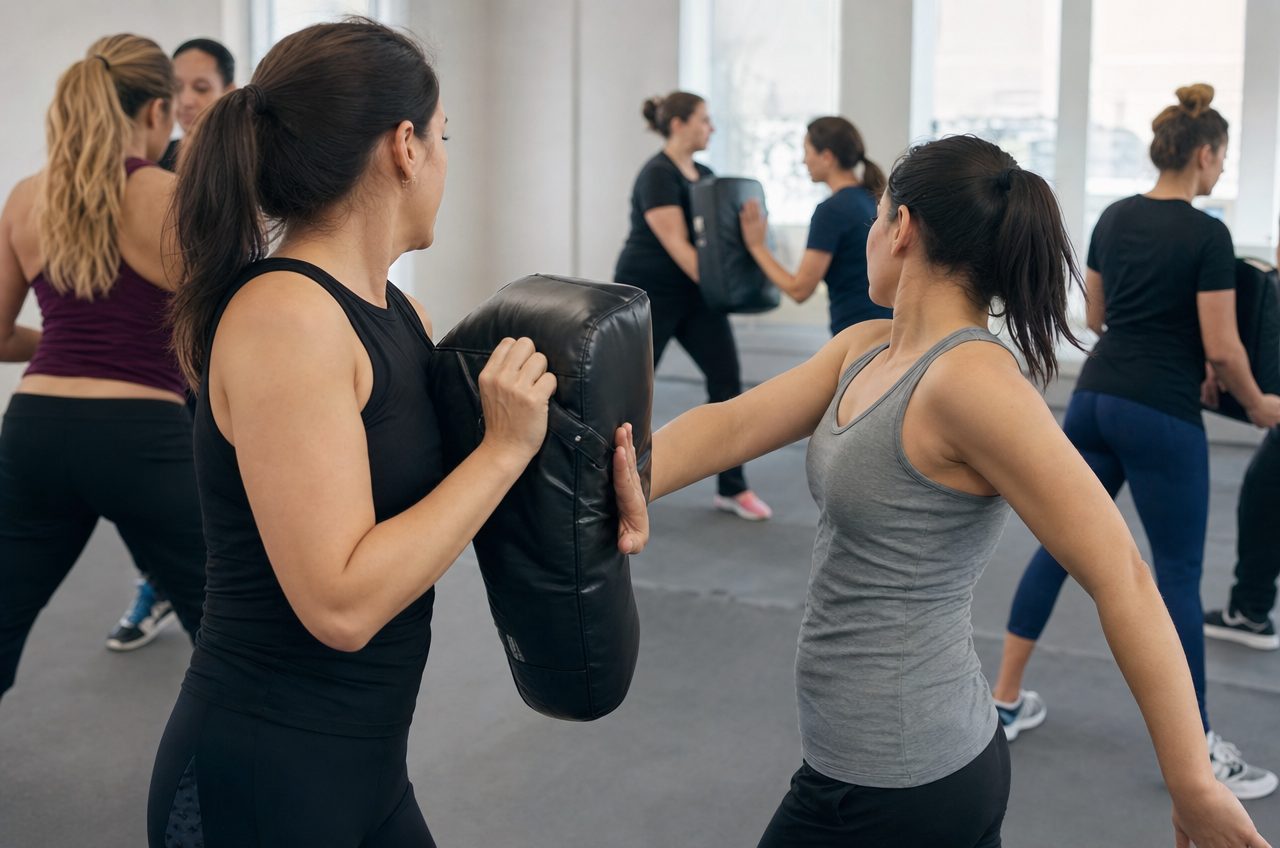
Most beginner-friendly classes start gently. Expect a warm-up to get the blood moving, then some basic striking on pads, palm strikes, elbows, knees, the kind of things that don’t require years of practice to land with some force. From there you’ll usually move into escapes from common grabs: wrist grabs, someone grabbing from behind, being pinned against a wall. These are taught slowly at first, with plenty of repetition, because the goal is that your body remembers the movement under stress, not that you memorise a checklist.
A good chunk of a first session is also just talk. Instructors typically spend time on awareness and boundary-setting, reading a situation before it turns physical, using your voice, exiting early. Most instructors will tell you upfront that avoiding a confrontation entirely beats winning one. That’s not a cop-out, it’s just realistic.
One-off workshops versus ongoing training
You’ll see both options advertised: a single two or three-hour workshop, or an ongoing weekly class. A one-off session can be a decent way to dip a toe in and get a feel for whether this kind of training suits you. But if you’re after something that actually sticks, ongoing training wins, and it’s not close. Physical skills under adrenaline need repetition. One session might give you a bit more awareness and a couple of moves you half-remember. Months of regular practice give you moves your body can actually produce without thinking about it. If budget or time only allows for one option, it’s worth checking whether a club offers a taster class as an entry point into ongoing training rather than treating the workshop as the whole plan.
Why combat-sport basics help
Scenario-based self-defence courses are useful, but a lot of instructors will point out that basic training in an actual combat sport, boxing, Muay Thai, BJJ, judo, complements that scenario work rather than replacing it. Sparring, even light sparring, teaches you things a scripted scenario can’t: how to stay calm when someone is actually coming at you, how to keep your hands up under pressure, how it feels to get hit and keep functioning. Grappling arts like BJJ are particularly relevant for the situation where a fight ends up on the ground, which is common in real altercations. None of this means you need to become a competitive fighter. Even a few months of casual training in a combat sport alongside a self-defence course tends to build confidence that carries over.
What to wear and bring
You don’t need anything fancy for a typical class. Comfortable athletic wear you can move in, closed shoes, and something to tie your hair back if it’s long. Some clubs run barefoot or in socks on mats, so check with the venue beforehand. Bring water, and a spare change of clothes if it’s after work, because you will get warm. A mouthguard usually isn’t needed for non-contact awareness classes, but if the programme includes any sparring drills it’s worth asking in advance whether protective gear is required or supplied.
Choosing between your options
There are a few different flavours of self-defence training around, and none is automatically the “right” one, it depends what you want out of it.
- Community-run courses, often through a local council or community centre, tend to be low-cost, short-format, and aimed at general awareness rather than deep skill.
- Dojo-run programmes, where a martial arts club runs a dedicated self-defence add-on to their regular classes, often blend technique with some real sparring exposure over a longer period.
- Dedicated women’s classes, run either standalone or inside a mixed gym, tend to focus specifically on scenarios and body types more relevant to women, and some people find the environment more comfortable to ask questions and practise without self-consciousness.
Whichever route you go, it’s worth asking a club about their instructor’s background, how much hands-on practice you’ll actually get versus lecture time, and whether there’s a free trial or observation session before you commit. Most clubs are used to these questions and happy to answer them.
Knowing where you stand legally
It’s worth understanding what NZ law says about self-defence before you assume any technique you learn is automatically “allowed” in a real confrontation. Reasonable force is the standard, and a decent instructor will touch on this rather than just teaching techniques in a legal vacuum.
If you’ve looked into krav maga as an option too, it’s a reasonable one to weigh up alongside more traditional self-defence courses, particularly if you want something with a heavier scenario-training focus. Whatever you pick, the main thing is getting started and sticking with it long enough for the training to actually mean something.