
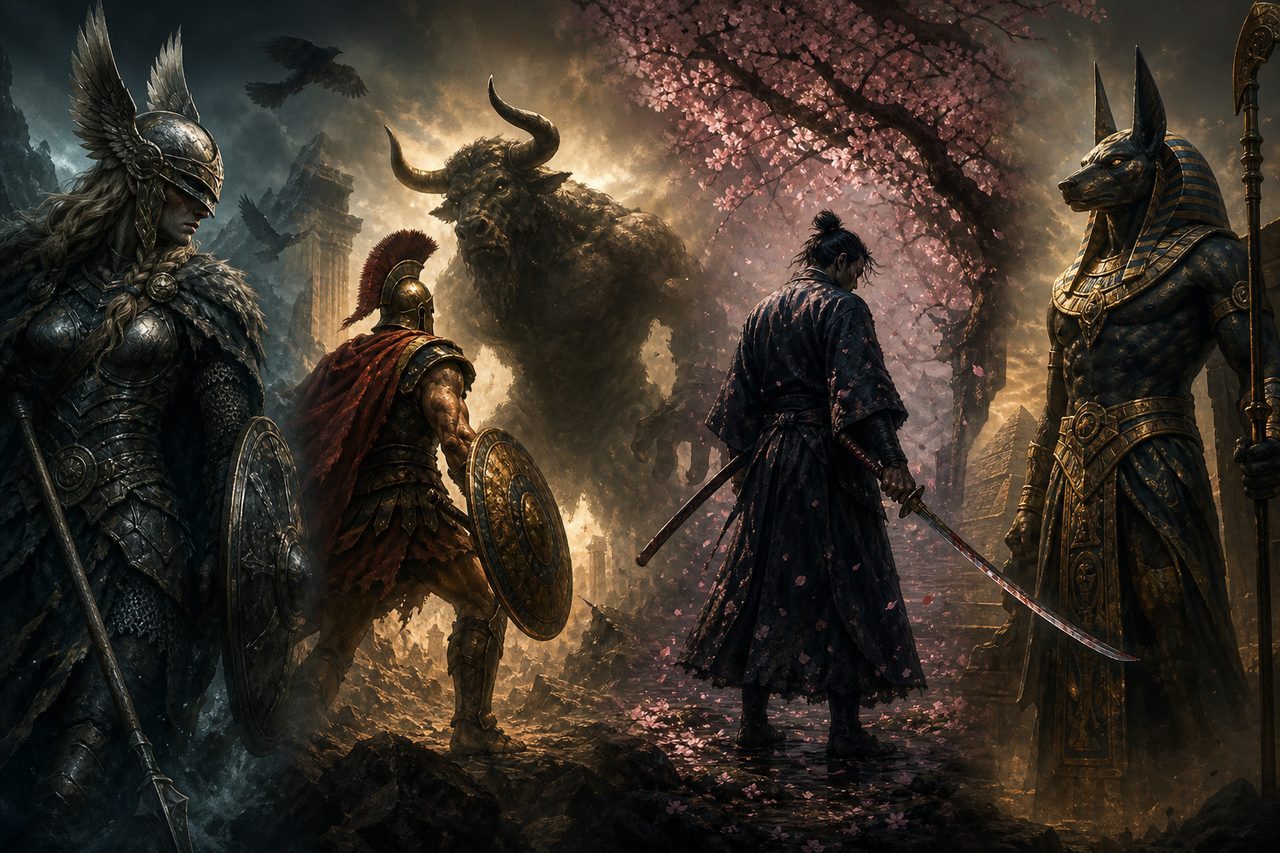
Every culture has its fighters. Long before the printing press or the cinema, people told stories about warriors who could level mountains, outwit gods and walk into the underworld and back again. Those figures never really left us. They moved into paintings, then into books and films, and now they fill the reels and tables of online games, where the old legends get a fresh coat of paint and a new audience.
For anyone who follows combat sports or martial traditions, the appeal is easy to understand. Mythological warriors are the original fighters, the ones whose discipline, courage and sheer aggression set the template that real fighters have chased ever since. Here are the figures developers return to most often, and why their stories travel so well.
The Norse pantheon
Few mythologies have proved as popular as the Norse one. Odin, Thor and the shield-maidens of Valhalla bring a ready-made cast of warriors, along with a worldview that treats battle as something close to sacred. The Valkyries, who chose which of the fallen earned a place in Odin’s hall, appear again and again, usually as the figures who unlock a game’s bigger features.
Part of the draw is the aesthetic. Longships, frost, raven banners and worn iron armour give designers a strong visual language to work with. The other part is the mythology’s appetite for confrontation. Ragnarok, the final battle that ends the world, hangs over every Norse story, and that sense of stakes carries neatly into a game built around risk and reward.
Greek heroes and monsters
Greek mythology offers something the Norse stories do not, which is a clear divide between the hero and the thing he has to beat. Hercules and his twelve labours, Perseus against Medusa, Theseus in the labyrinth with the minotaur, these are clean confrontations with a clear winner. That structure suits a game well, because every spin or hand becomes its own small contest.
The gods themselves add another layer. Zeus throwing lightning, Poseidon stirring the sea, Hades ruling the dead, each one comes with imagery that needs no explanation. A martial arts audience tends to appreciate the Greek emphasis on training and technique too. Many of these heroes win through preparation and cunning rather than brute size, which is a lesson any grappler or striker will recognise.
The warriors of Japan
Japanese mythology and history blur together in a way that designers love. The samurai sits at the centre, bound by a code that prized discipline and self-control as highly as skill with a blade. Around him gather the oni, the horned demons of folklore, and the tengu, the bird-like spirits said to have taught swordsmanship to legendary fighters.
The visual restraint of Japanese design also stands out. Where Norse and Greek games tend toward spectacle, the Japanese style often leans on space, calm and a single sharp detail, a falling cherry blossom or the gleam of a drawn katana. For practitioners who follow disciplines rooted in Japanese tradition, that quiet intensity rings true to the source.
Gods of ancient Egypt
Egyptian mythology has become almost a genre of its own. Anubis, the jackal-headed guardian of the dead, and Ra, the sun god, anchor countless titles, usually wrapped around the idea of a buried tomb and a reward waiting inside. The warrior element here is less about open combat and more about the trial, the journey through the underworld that a soul had to survive to reach the afterlife.
That theme of passing a test to claim a prize is a near-perfect fit for the format. It explains why Egyptian themes have stayed near the top of the pile for so long, outlasting plenty of trends that came and went around them.
Why the old stories still work
What links all of these is conflict with meaning behind it. A myth is rarely just a fight. It carries ideas about honour, sacrifice, fate and the price of victory, and those ideas give a game more weight than flashing lights and a soundtrack ever could. The combat sports crowd understands this instinctively. A bout is never only about who hits harder. It is about preparation, character and the story a fighter writes over a career.
These mythological figures have found a second life across online slots and table games, where developers lean on the same warrior archetypes that have anchored legends for centuries. For players here curious about trying them, it is worth knowing that New Zealand’s online casino laws changed significantly in 2026, with a formal licensing system now deciding which operators can legally offer these games. Knowing the current rules is a sensible first step before spinning up a Valkyrie or facing down a minotaur for real money.
Finding your legend
The pleasure of mythological games is the range. You can stand on a longship with the Norse raiders, test yourself against the monsters of Greece, walk the disciplined path of the samurai or chase treasure through an Egyptian tomb. Each tradition carries its own mood, its own pace and its own kind of hero. The best way to find the one that suits you is to read a little of the mythology behind it first. The stories are older than any game, and knowing them makes the games far richer to play.